Learning about cloth and thread 15 (Kogin Dwell)
◆Learning about cloth and thread 15 (Kogin Dwell)
This is the fifth fabric in my materials study series. This time, I’m looking at Kogin Dwell. I’ve used this fabric in more of my kits than any other, so I’m very familiar with stitching on it. But when I took a closer look, I still discovered a lot of interesting things.
The letters used for fabric names and the numbers used for thread names are for reference only.
◆Basic Information: Kogin Dwell
・Material: Linen
・Number of threads per 1 cm² (vertical : horizontal): 7 : 9
・Purchased from: Tsugaru Koubousha and Shimaya
・Purchased around 2022
(I’m including the purchase date because there may be slight differences between production lots.)
・Please contact the manufacturer for current colors, prices, and other product information.
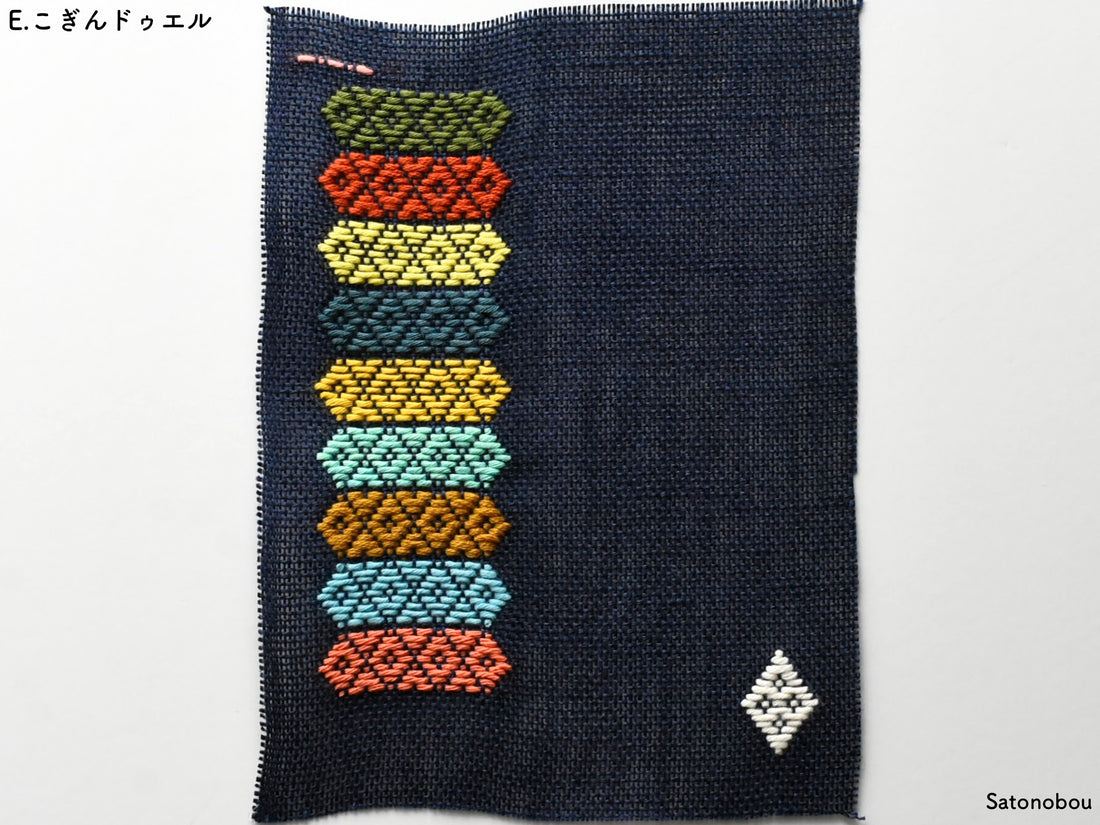
At a glance, this is what the fabric looks like.

(At a glance, the cloth looks like this.)
◆My Impressions of Kogin Dwell
・The fabric contains quite a lot of sizing, so I feel it works well with threads that have a little more firmness and structure.
・The fabric moves as a whole when stitching, so I think it is important to adjust the thread carefully as you go.
・Because the warp threads can sometimes split, I find it helpful to think about gently lifting the warp threads rather than aiming directly for the holes in the fabric.
In the macro photo below, you can see that the spaces between the threads are vertically elongated. There are also fewer fuzzy fibers on the surface, which makes the fabric structure fairly easy to see, even for beginners. This is one reason I have used Kogin Dwell in many of my kits.
However, until you get used to the fabric, it is possible to split the warp threads, so I recommend stitching slowly and carefully at first.


In the photo above, I lined up warp threads from different fabrics. Kogin Dwell is the second from the right. You may be able to see how firm and crisp its warp threads look.
I hope we can enjoy choosing different fabrics and threads depending on the kind of piece we want to create.

◆Threads I’d Like to Use Again with Kogin Dwell
All of these samples were stitched with the same Kogin needle using the same stitching method.
Please keep in mind that my own stitching technique may affect both the appearance and how the thread feels while stitching.

⚪︎5. Tsugaru Kogin thread from Tsugaru Kobosha
Stitching feel: Smooth and easy to pull through the fabric.
Appearance: The thread is delicate but still has enough structure to stand up to the firmness of the fabric, giving the finished piece a soft look.
My impression: Although this Kogin thread feels soft, it also has good structure, so it keeps its shape well and makes stitching smooth and comfortable.
⚪︎6.1chi® Kogin thread
Stitching feel: You may notice a little friction, but I actually find that reassuring and comfortable.
Appearance: Soft and plump, with very little thread disturbance.
My impression: I like both the stitching feel and the finished look.
⚪︎8.Hand-dyed Kogin Thread by Teshigotofan
Stitching feel: Smooth, with a comfortable amount of friction.
Appearance: The natural texture of the thread comes through beautifully.
My impression: I feel this thread works well with many different fabrics, and Kogin Dwell was no exception.
⚪︎9.Kogin Thread by koginbank
Stitching feel: Very comfortable.
Appearance: The unique character of koginbank thread comes through clearly.
My impression: I really enjoyed stitching with it.
⚪︎Other thoughts
Overall, I felt that Kogin Dwell works well with many different types of thread.
However, with my own stitching technique, loosely twisted threads such as Olympus, Daruma, and Matalbon sometimes felt a little less stable on the fabric.
(I used Olympus and Matalbon without combining multiple strands.)
On the other hand, more tightly twisted threads seemed to work especially well with the character of this fabric, which I found very interesting.
◆ Kits Using Kogin Dwell
・Kogin embroidery kit 6
・Kogin embroidery kit 7
・Kogin embroidery kit 8
・Kogin embroidery kit 9
・Kogin embroidery kit 10
・Book cover 1
・Kabuto A decorative samurai helmet for Children’s Day
・Koinobori Carp streamer 2
・Kogin ️Bouquet
◆Next Time

Next time, I’ll look at Olympus linen. I was able to make some progress on this while I was back home in Aomori, so I hope to share more soon.
◆About Fabric and Thread Compatibility
As I mentioned in Learning About Fabric and Thread 3, everyone has different preferences and different ways of stitching.
When I talk about “compatibility,” I don’t mean that one combination is good and another is bad. I simply want to show that the stitching feel can change depending on the combination of fabric and thread.
One reason I started this research is that I think it would be a shame to avoid a fabric or thread just because of a first impression.
My goal is to discover the positive qualities of each material.
◆About This Materials Study
This information is based on materials I personally own and have tested while enjoying Kogin stitching.
Please keep in mind that thread count, weight, or feel may vary depending on storage conditions or production lots.
Please do not use the photos without permission.
I hope you enjoy your Kogin time.
Satonobou